Case workspaceDemo buildSep 2026
Cold cases persist. So does the record.
Second Trace is a workspace for organizing cold-case information with total provenance — evidence-backed timelines, source-cited claims, relationship analysis, and grounded assistance. Built so disciplined inquiry can continue across years without losing the thread.
The instruments, running on the demo case
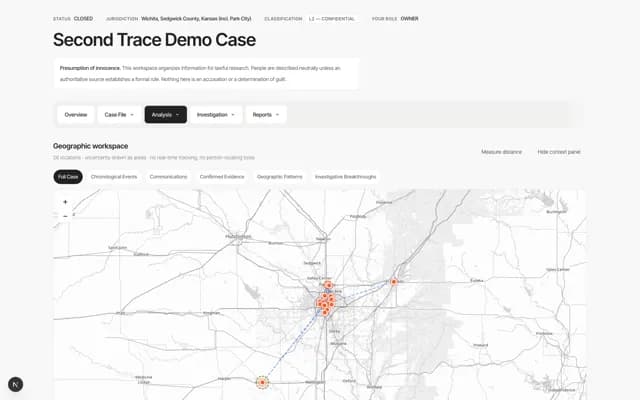
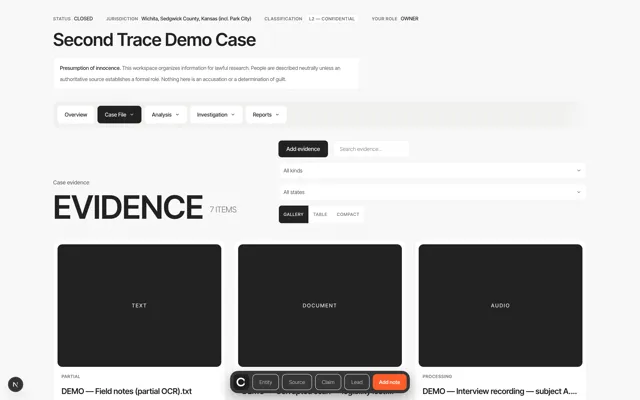
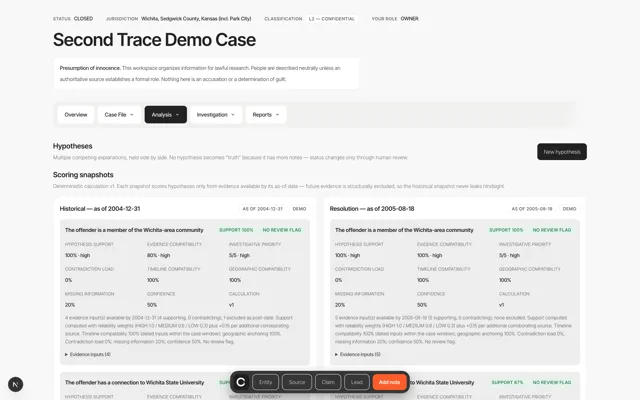
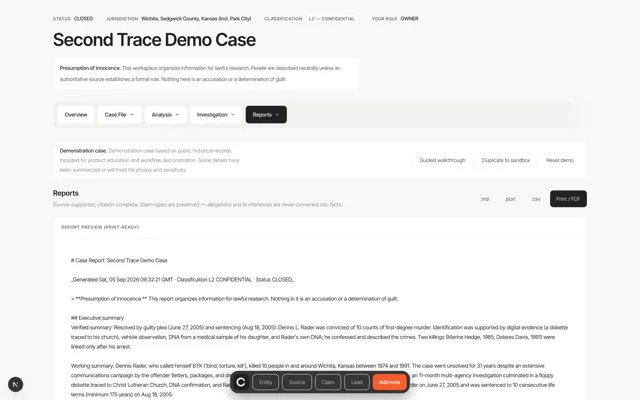
Workspaces
One case, many instruments
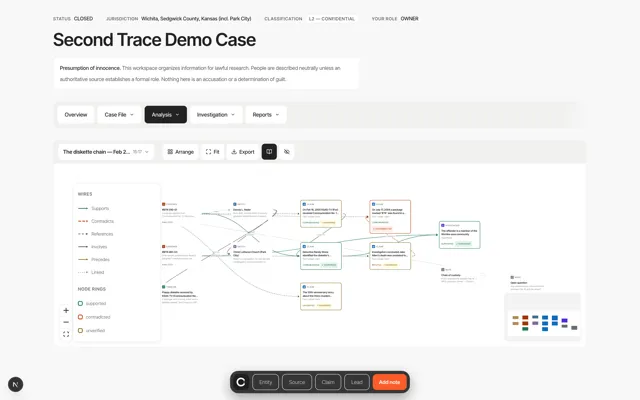
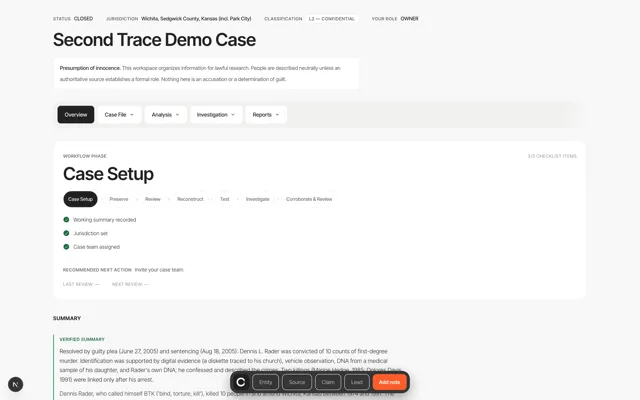
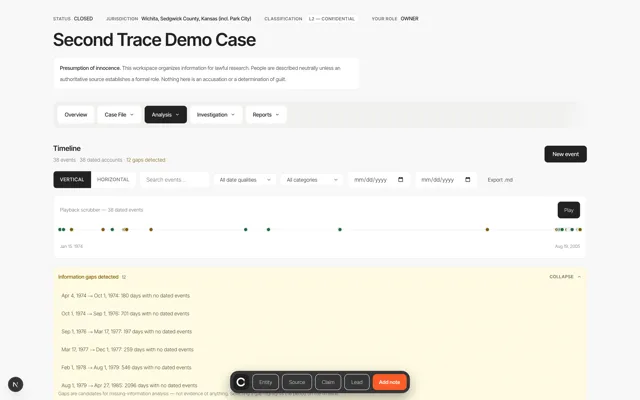
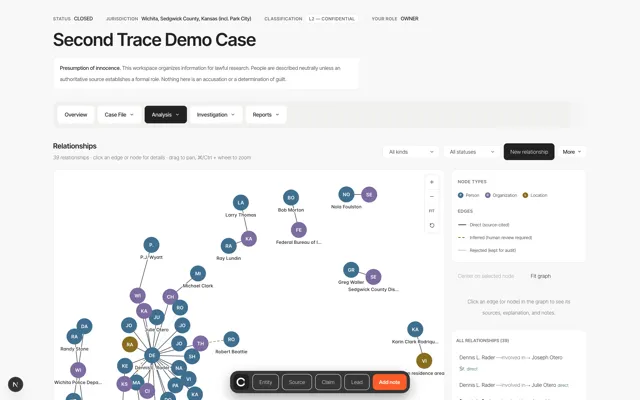
Eight instruments on one cited record — work done in one view strengthens every other. Select an instrument to see the workspace itself, running on the public demo case.
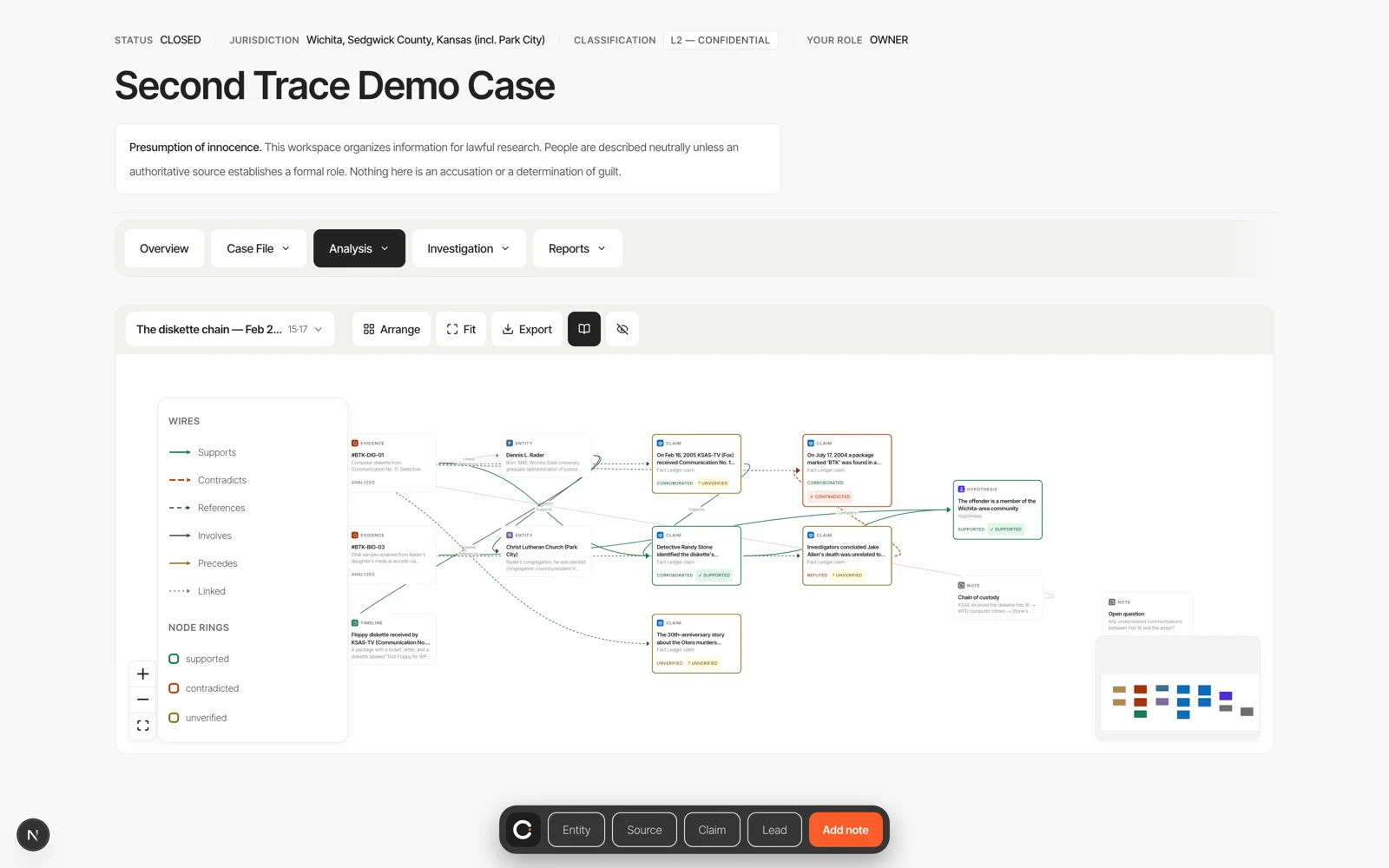
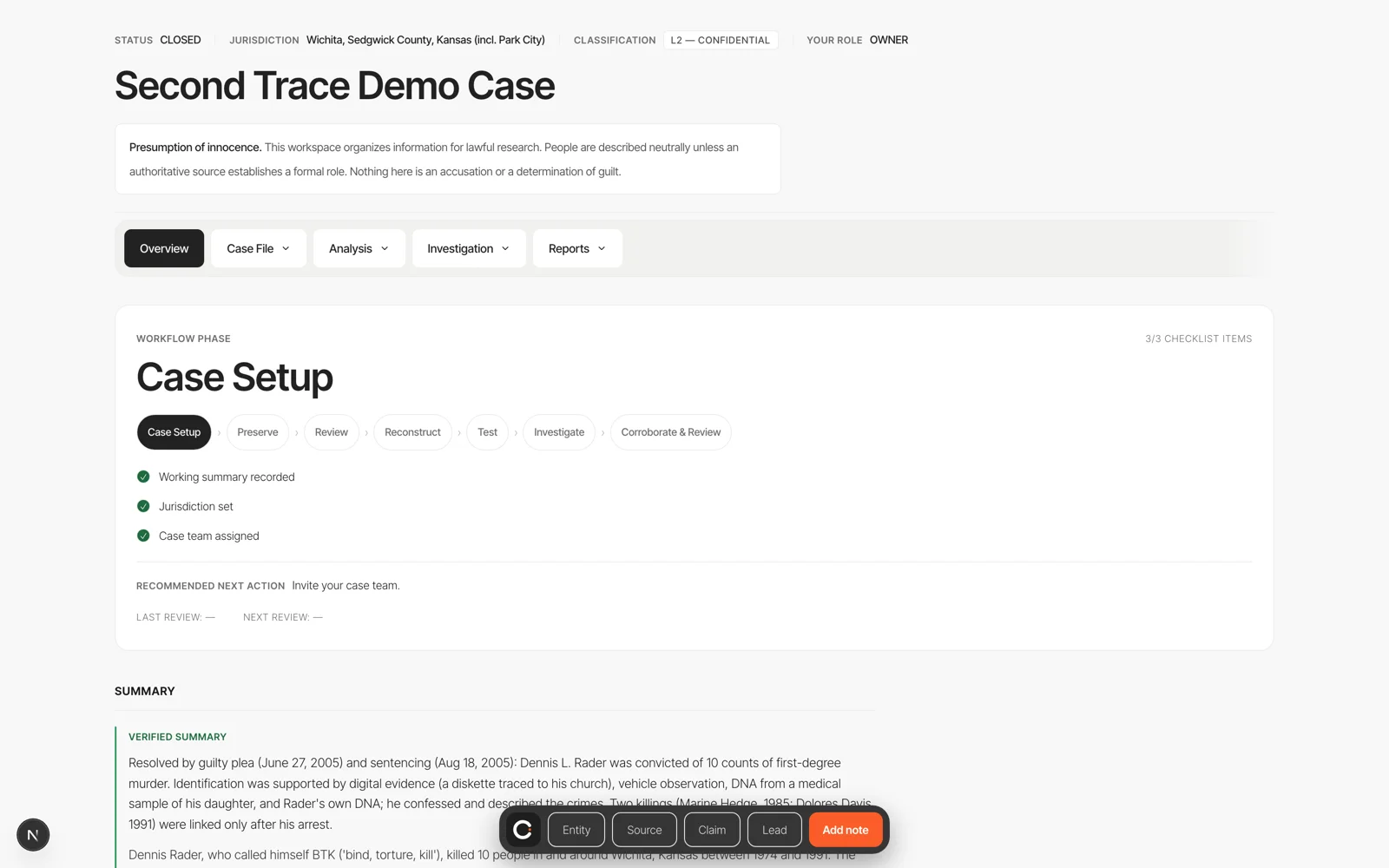
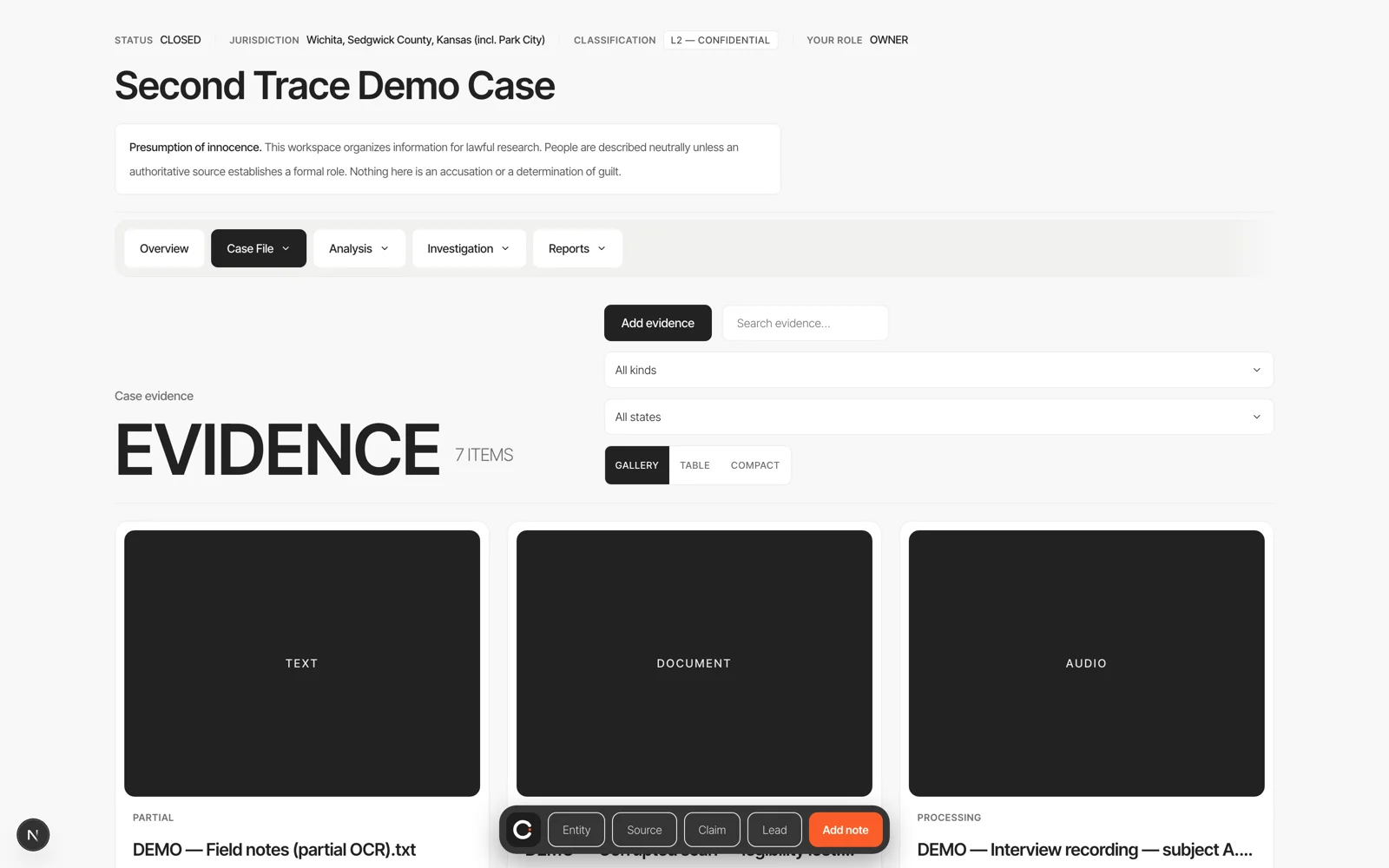
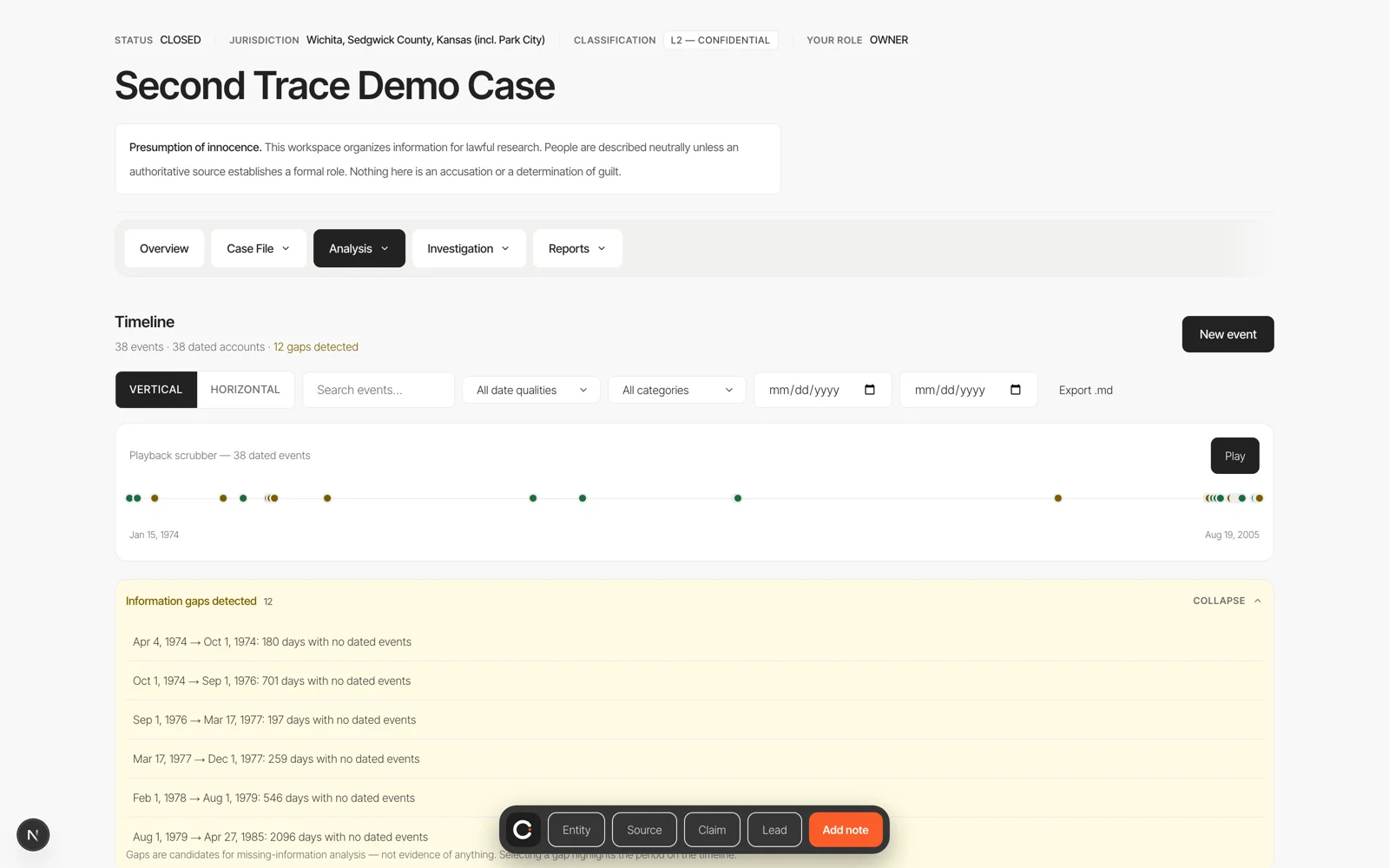
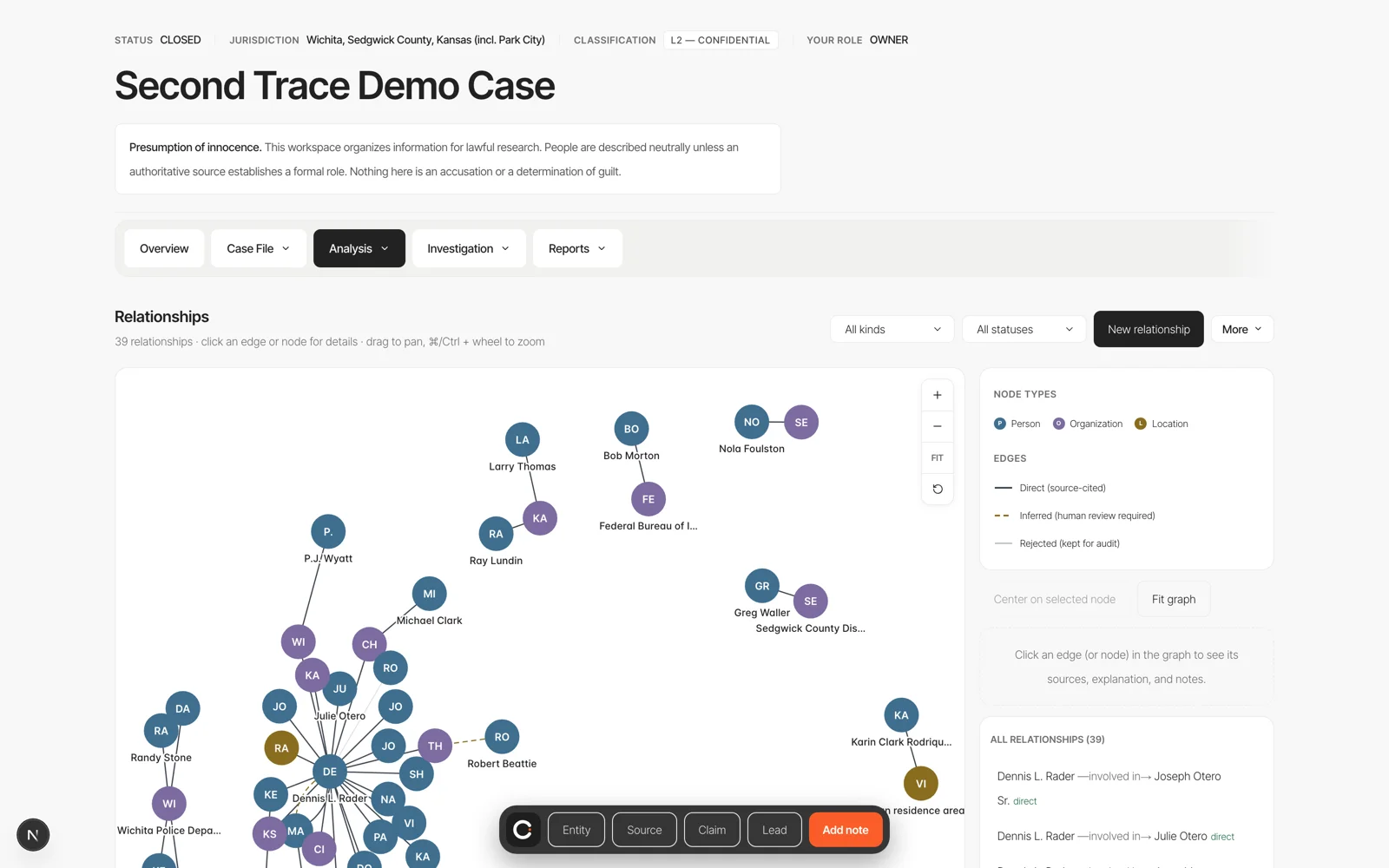
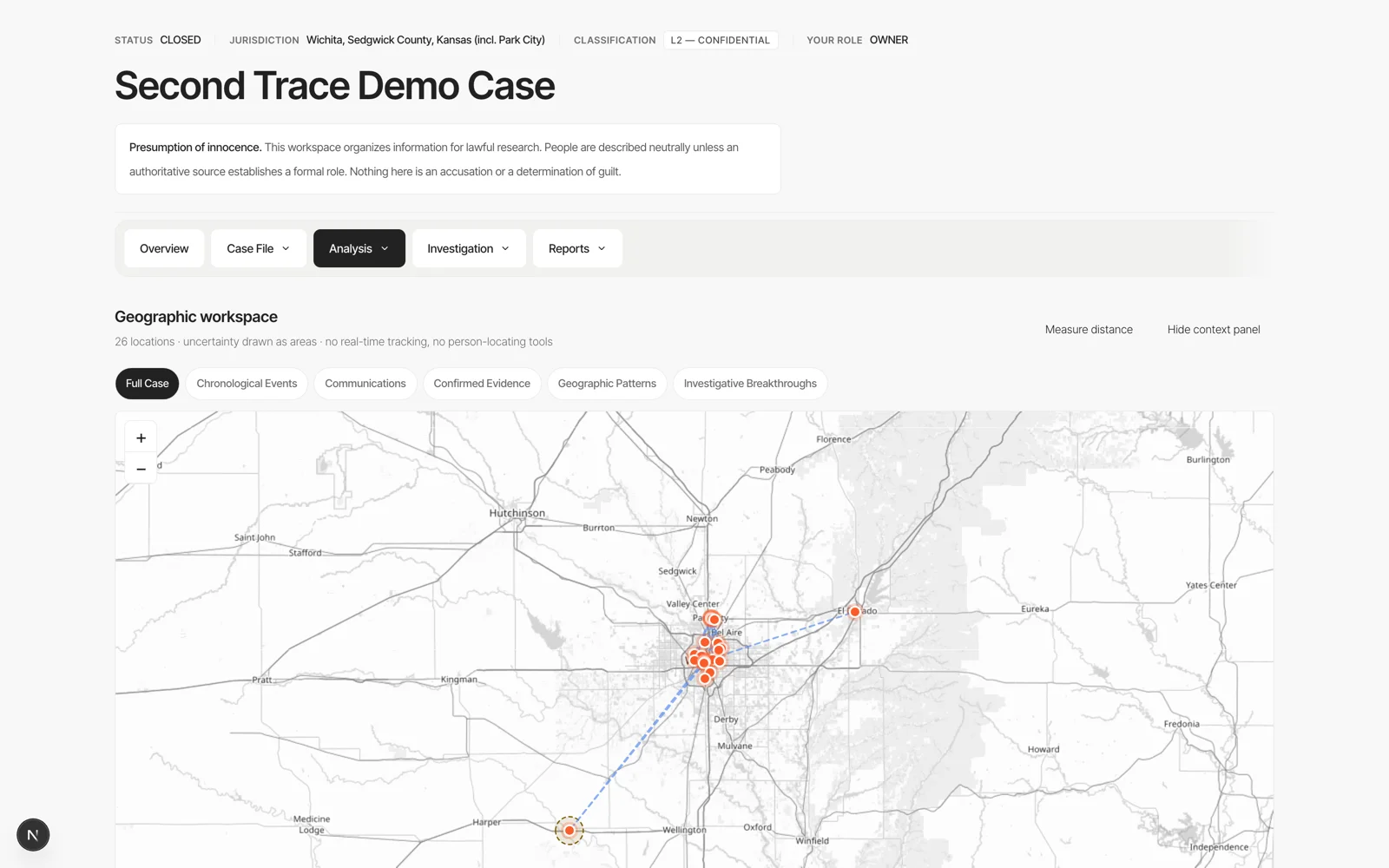
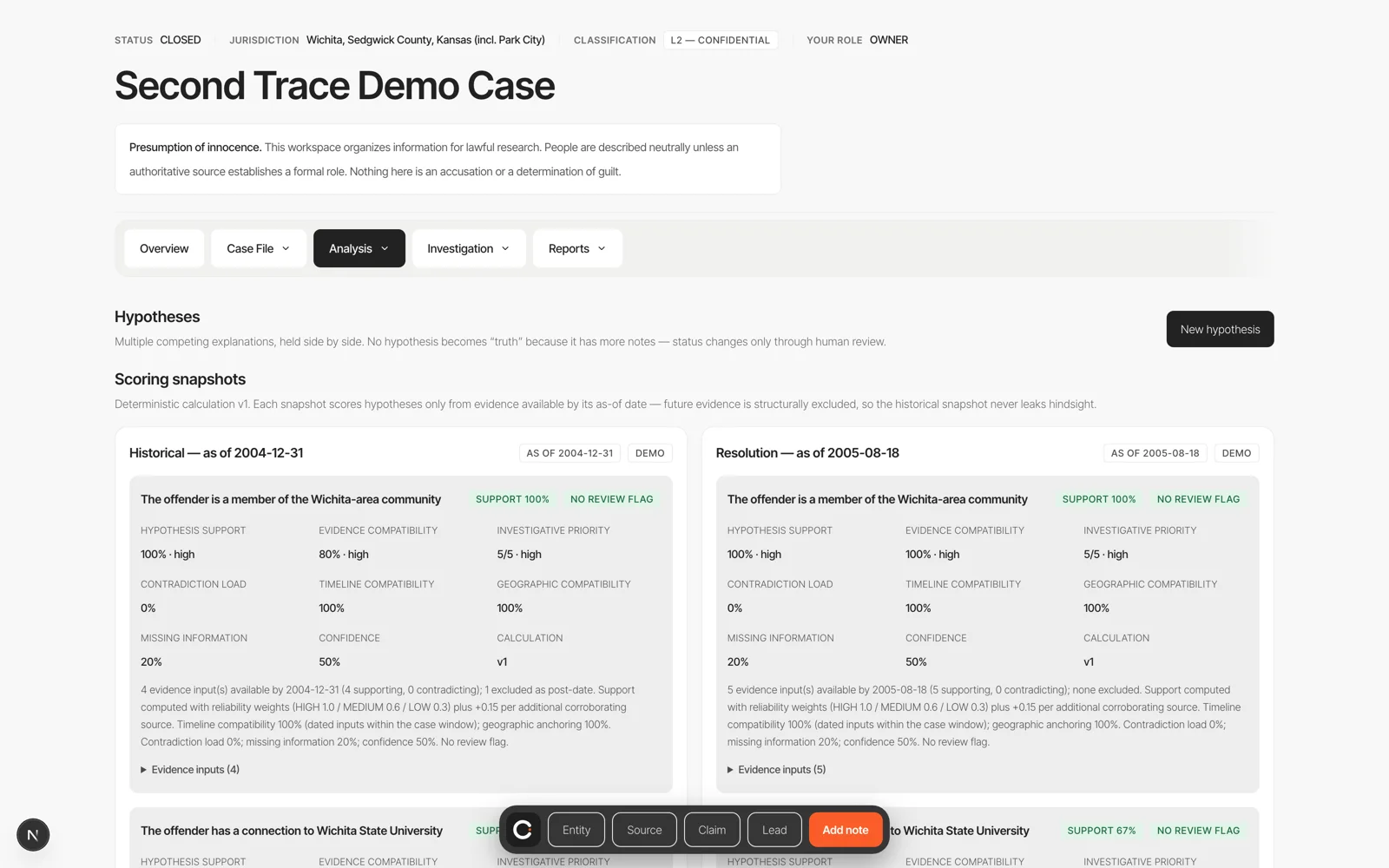
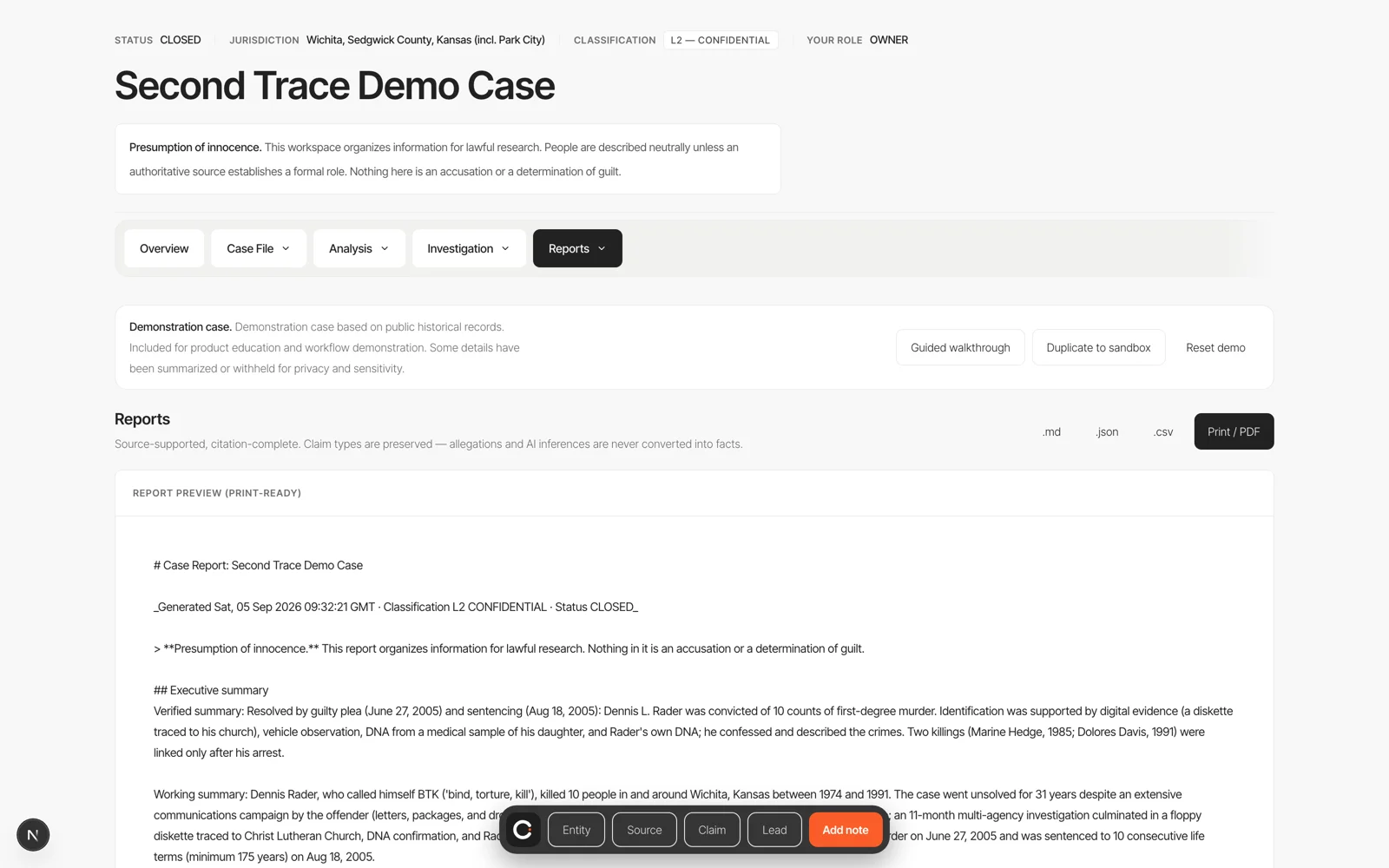
Screens from the built-in demonstration case, which runs on public historical records with synthetic fill-in data. No private case material is shown.
Principles
01
Every fact traceable
Claims, accounts, and relationships carry their source and exact location.
02
Every uncertainty visible
Disputed, approximate, and unknown states are first-class — never smoothed over.
03
Nothing invented
AI output is labeled, cited, and requires human verification. Insufficient evidence is a complete answer.
Worked example
One claim, end to end.
Follow a single claim through the workspace — from the page it came from to the hypothesis it holds up, or the contradiction it runs into. Every hop is typed, cited, and reviewable.
Source
A page in the record
A February 2005 news story reports a diskette mailed to a local station. It enters the evidence library with provenance, custody, and a redaction preview.
Evidence
An item, addressed
The diskette is logged and content-addressed. Every later finding — metadata, software traces, an office link — points back to this one item.
Claim
A claim, corroborated
“The diskette's software traces to a specific church office.” Typed as fact, cited to its source, and marked corroborated — not just asserted.
Contradiction
A dispute, held open
A rival account says otherwise. The timeline holds both side by side — never merged — and the contradiction stays visible until evidence resolves it.
Hypothesis
A theory, falsifiable
“The offender lived within the area.” Scored against the record with support, contradictions, and the conditions that would kill it. Still open, still honest.
This is the shape of the built-in demonstration case — public historical records, neutrally described.How neutrality is enforced →
Trust
Built to be trusted with the record.
Case material is treated as highly sensitive by default. The architecture is defensive in depth — nothing here depends on trust in the interface alone.
Isolation at the database
Row-level security on every table. Cross-tenant reads and writes are denied by the database itself — and an automated suite proves it for every resource class.
Evidence that can't be quietly changed
Uploaded originals are immutable and content-addressed (SHA-256). Audit events are append-only: the database rejects updates and deletes.
Nothing trains on your case
AI processing sends only explicitly scoped, case-authorized content to the configured provider — local by default. No case material trains any model.
Encrypted, recoverable
Backups are encrypted and restoration is tested. Version history is preserved for claims, notes, entities, and timeline events.
Controls are documented against common frameworks such as the NIST 800-53 control families. Second Trace does not claim formal compliance or certification — those require independent audit, and we say so plainly.
Responsible by design
Presumption of innocence is not a banner. It is the system.
Second Trace describes people neutrally until a source establishes a role. It never scores guilt, never ranks suspects, and refuses to convert allegations into facts. Built for lawful research and authorized casework only.
Read the responsible-use policy →